The “Traffic Paradox”
Imagine this. You own a shop on a busy street. Every single hour, hundreds of people walk through your front door. The floor is packed. It looks like a success.
But at the end of the day, you look at the cash register. It is almost empty. Out of a thousand visitors, only one person bought something.
Now, ask yourself a serious question. Would you go out and pay for a massive billboard to bring more people into that shop?
Of course not. That would be financial suicide. You would fix the shop first. You would figure out why everyone is leaving empty-handed. You would fix the messy shelves, the rude staff, or the confusing price tags.
The hole in the bucket
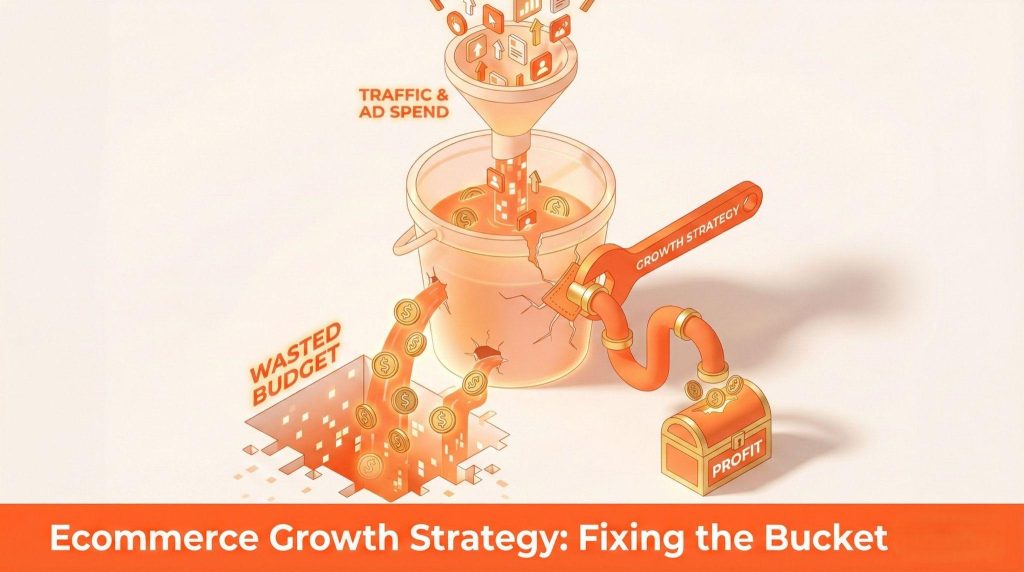
In the physical world, this logic is obvious. But online, business owners do the exact opposite every day. They see low sales, so they panic. Their first instinct is to “turn on ads.” They spend thousands of dollars on Google and Facebook to drive more traffic to a website that isn’t selling.
They are pouring water into a bucket full of holes. This is the Traffic Paradox. We get obsessed with visitor numbers because they are easy to see. But traffic does not pay the bills. If your website confuses your customers, sending more people there won’t solve the problem. It just burns your budget faster.
You don’t need more visitors (Yet)
Stop chasing clicks. If you want to scale, you need to shift your focus. You don’t need a bigger marketing budget; you need a better ecommerce growth strategy.
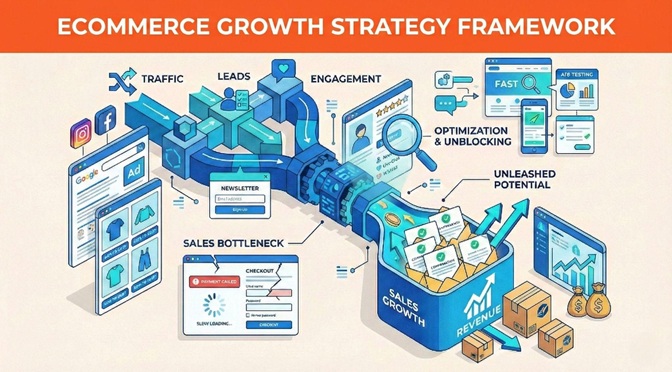
A true strategy focuses on the foundation. It looks for sales bottlenecks, the specific places where your customers get stuck and leave. It prioritises your profit margin over your page views. It ensures that when you finally do spend money on ads, every dollar works harder for you.
Why traditional marketing is broken
If you have ever hired a marketing firm, you probably know this feeling. At the end of the month, you get a beautiful PDF report. It is full of colourful charts. It shows green arrows pointing up. It says you got 500 new likes, 10,000 impressions, and a higher click-through rate.
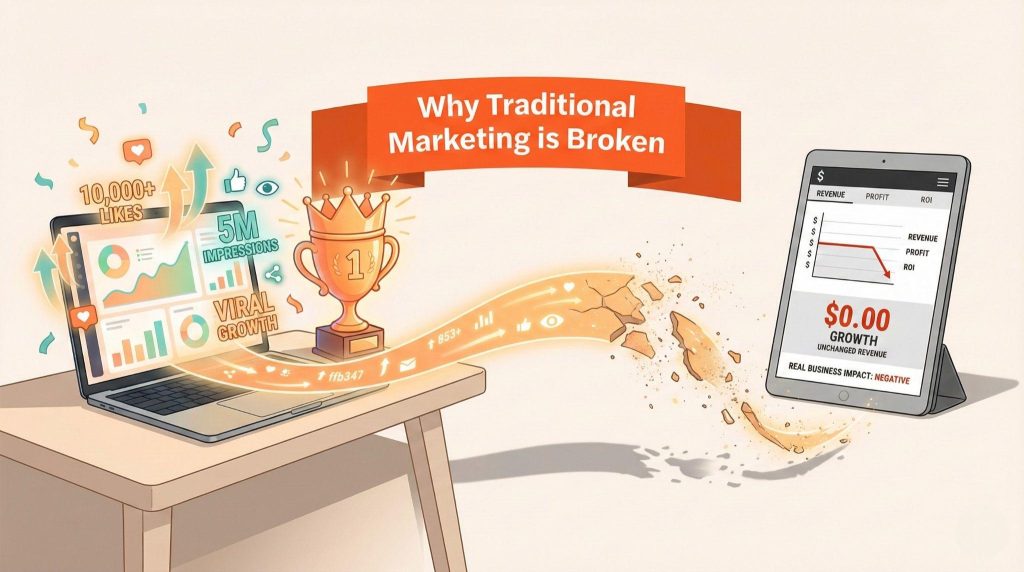
The agency team is celebrating. They did their job.
But you look at your bank account, and the number hasn’t moved.
The “activity” trap
This is the biggest trap in the industry. Most service providers sell you “activity.” They sell you hours of work. They write blog posts nobody reads, post social media updates that nobody shares, and run ads that bring people who don’t buy.
The typical ecommerce marketing agency is built to deliver these tasks. Their business model depends on checking boxes. Did we post three times this week? Yes. Did we update the meta tags? Yes.
But “doing things” is not the same as “getting results.” You can be very busy and still go broke.
Likes don’t pay the rent
Let’s be honest about the metrics. “Likes” are vanity. “Impressions” are just noise. You cannot pay your warehouse staff with retweets. You cannot buy new inventory with page views.
I have seen businesses with 100,000 Instagram followers that struggle to make a profit. I have also seen businesses with almost no social media presence that generate millions in revenue.
The difference is focus. The struggling business is chasing applause. The successful business is chasing customers.
The mindset shift
To fix this, you need to change how you look at your store. You need to stop thinking like a marketer and start thinking like a business owner.
A marketer asks, “How do we get more traffic?” A business owner asks, “How do we get more profit?”
These are very different questions. When you focus purely on business growth, you stop caring about being “popular” on the internet.
You start caring about the data that actually matters: your conversion rate, your average order value, and your return on investment. You stop asking for “viral content” and start asking for “content that converts.”
Service provider vs. Growth partner
This brings us to the most important definition you will learn today. You don’t need another vendor who sends you an invoice every month for “SEO services.” You need someone who is obsessed with your bottom line.
This is the fundamental difference between a general agency and a dedicated ecommerce growth partner.
A service provider executes a task. They will fix your broken link because you paid them to fix it. A partner, however, looks at the bigger picture. A partner might tell you, “Don’t fix that link. Delete that page entirely because it’s distracting your customers from the checkout button.”
A partner operates with a revenue focus. They don’t celebrate when traffic goes up; they celebrate when sales go up. They understand that if you don’t grow, they don’t succeed. That shared risk and shared vision is the only way to break through the noise in 2026.
Framework 1: The diagnosis (Finding the leak)
You cannot fix a house if you don’t know where the leak is. If the roof is leaking, fixing the window won’t help. You will just get wet and frustrated.
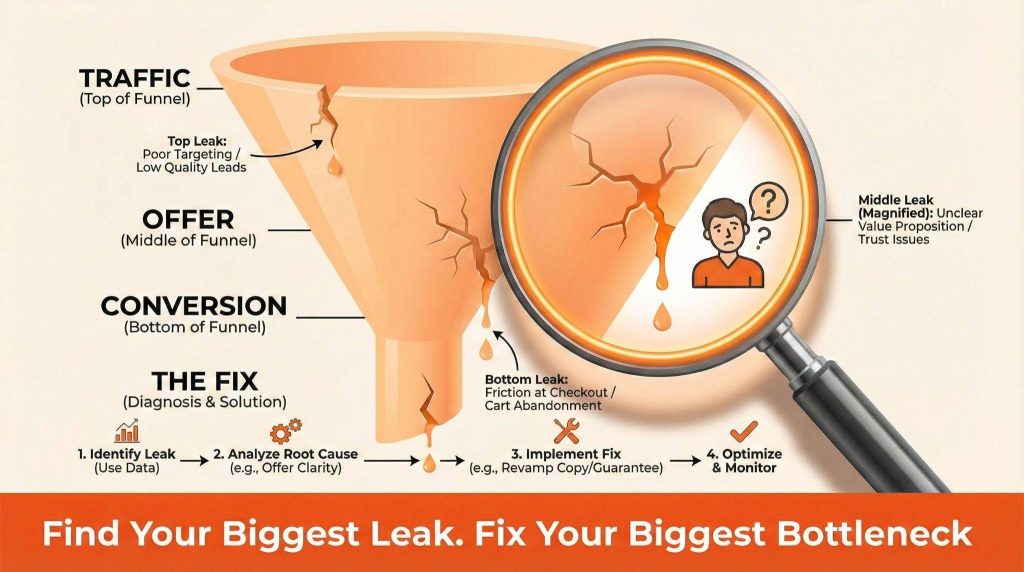
In ecommerce, many business owners try to fix everything at once. They change the colours, rewrite the emails, and fire the ad agency all in the same week. This is panic, not strategy.
To grow, you need to stop guessing. You need to perform a targeted diagnosis. We call this a website audit, but it doesn’t have to be complicated. You just need to look at your sales funnel the path people take from “visitor” to “customer” and see exactly where they fall off.
Here are the three most common leaks.
Step 1: The traffic check (The “window shopper” problem)
First, look at the people landing on your site. Do they stay and read, or do they leave instantly?
If you have a high bounce rate, meaning people land on your page and leave without clicking anything, you have a traffic problem. It means you are inviting the wrong people.
Imagine you sell expensive, high-end leather boots. But your ads are targeting teenagers looking for cheap sneakers. They click your ad, see the $300 price tag, and leave immediately. Your site isn’t broken; your invitation is. You don’t need to change your website; you need to change who you are targeting.
Step 2: The offer check (The “trust” problem)
What if people stay? They look at your products. They scroll through the photos. They might even visit the “About Us” page. But they never add anything to the cart.
This is an “Offer Problem.”
They are interested in what you sell, but they are not convinced to buy it from you.
Usually, this happens for two reasons:
Price shock: Your price is higher than they expected, and you haven’t explained why your product is better.
Trust Gap: They don’t see any reviews, clear shipping info, or guarantees. They are scared to take the risk.
When you see this kind of customer drop-off, changing your logo won’t help. You need to work on building trust and explaining your value.
Step 3: The checkout check (The “friction” problem)
This is the most painful leak of all. A customer adds a product to their cart. They click “Checkout.” They are ready to give you money.
And then they quit.
If you see a lot of “Abandoned Carts,” your problem is not your product. Your problem is your process. Your checkout is likely too hard, too slow, or too surprising. Maybe you forced them to create an account. Maybe you surprised them with a high shipping cost on the last page.
This is where conversion rate optimisation (CRO) becomes your best friend. Even a small fix here, like adding a “Guest Checkout” option, can double your sales overnight.
Action plan
Stop guessing. Open your Google Analytics right now. Look at these three stages.
- Do they leave instantly? (Fix your ads).
- Do they look but not touch? (Fix your offer).
- Do they add to the cart but not buy? (Fix your checkout).
Find the biggest leak. That is your bottleneck. Fix that first.
Framework 2: The trust factor (B2B secrets)
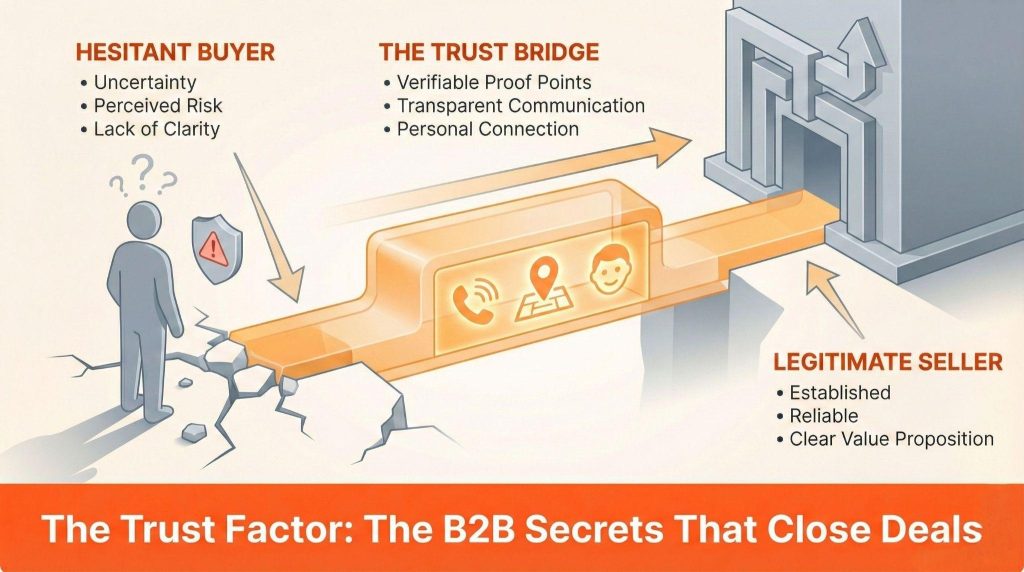
Let’s play a quick mental game.
Imagine you are on a website you have never seen before. You see a cool t-shirt for $20. The photos look okay. The price is low. You might think, “Why not?” and click buy. If the shirt never arrives, you lose $20. It is annoying, but it won’t ruin your week.
Now, imagine you are a business owner. You need to buy five hundred uniforms for your staff. The total cost is $15,000. You land on a new website. It has great photos. It has a nice logo.
But you cannot find a phone number. You cannot find an address. You check the “About Us” page, and it just says, “We are a leading provider of quality goods.” There are no names. There are no photos of the team.
Do you click buy?
Absolutely not. You leave immediately.
The high-stakes game
This is the reality of B2B ecommerce. When you are selling to other businesses or selling expensive “high-ticket” items, pretty pictures are not enough.
In the B2B world, the buyer is under pressure. If they buy a bad product for themselves, they lose money. If they buy a bad product for their company, they might lose their job. They are scared of making a mistake.
Your job is not just to sell a product. Your job is to remove that fear. We call this process building trust.
The “trust signals” checklist
To sell to these serious buyers, your website needs to prove it is a real, breathing business, not just a teenager with a laptop in a basement. You need Trust Signals.
Here are the three most powerful signals you can add today.
The real phone number (Stop hiding)
Many online store owners are afraid of the phone. They think, “If I put my number up, people will bother me.”
If someone calls you, that is not a “bother.” That is a customer trying to give you money.
In a solid wholesale strategy, hiding your contact info is deadly. A hidden phone number tells the buyer, “I don’t want to talk to you.” A visible phone number tells them, “We are here. We are real. We can help.”
The physical address
Where are you? Are you in a warehouse in Sydney? Are you in an office in London? Or are you nowhere?
B2B buyers check this. They look at your footer. If they see a P.O. Box or no address at all, their “scam alarm” goes off.
You don’t need a fancy skyscraper. You just need to show a real location. It proves you are subject to local laws. It proves you have inventory. It proves you aren’t going to vanish the moment the credit card payment clears.
The “about us” Page (Show your face)
This is the most neglected page on the internet. Most businesses fill it with boring corporate words. “We utilise best-in-class synergy to deliver excellence.”
Nobody reads that.
People buy from people. If you want to build trust, show your team. Put a photo of yourself on the site. Write a story about why you started the business.
When a buyer sees a smiling human face, their brain relaxes. They realise, “Okay, there is a person behind this screen.” It creates a connection that a logo never can.
The bottom line
If you want to sell cheap trinkets, you can be anonymous. But if you want to build a serious brand, you must be transparent. Open your doors. Pick up the phone. Show your face.
Trust is the currency of business. If you don’t have it, you cannot buy growth.
Framework 3: Frictionless design (Make buying easy)
There is a golden rule in web design that every business owner must memorise: “Don’t make me think.”
Your customer is busy. They are likely on their phone, holding a coffee in one hand and scrolling with the other. They are distracted. If they have to pause for even one second to figure out how to buy your product, you have lost them.
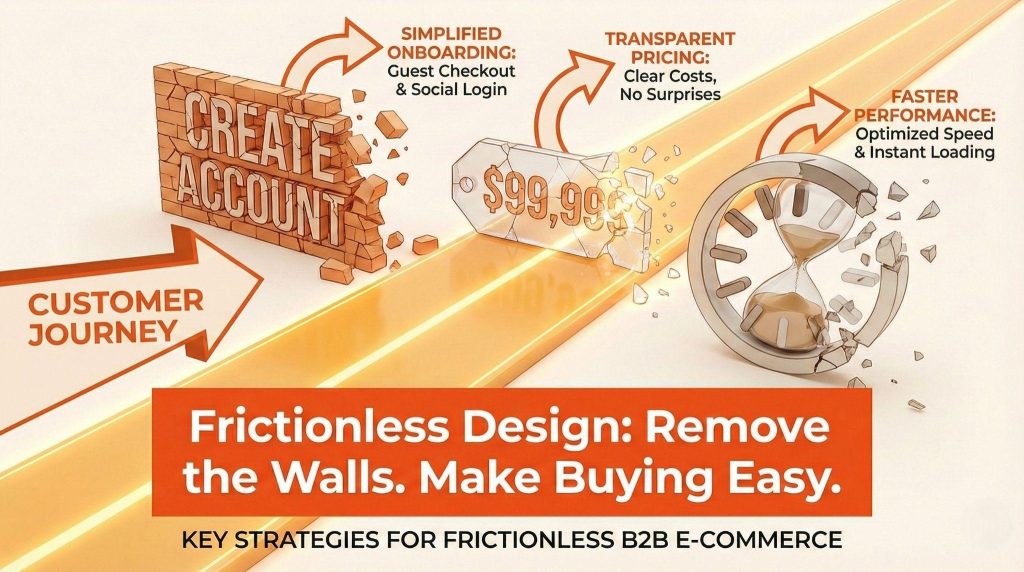
Great design is not about flashy animations or cool colours. Great design is about removing obstacles. We call this Frictionless Design. It means smoothing out the road so the customer can slide right into the checkout.
However, most online stores do the opposite. They build walls. Here are the three biggest mistakes that kill sales.
The “create account” wall
Imagine walking into a supermarket to buy milk. You get to the counter, and the cashier stops you. “Before I sell you this milk,” they say, “you must fill out this form, create a password, and verify your email address.”
You would leave the milk on the counter and walk out.
Yet, thousands of websites do this every day. Forcing a customer to create an account before they buy is the fastest way to kill a sale. It feels like work.
The Fix: You must offer Guest Checkout. Let them buy first. You can ask them to save their details after they have paid.
The shipping cost surprise
This is the number one cause of cart abandonment.
A customer sees a product for $50. They are happy. They click “Checkout.” They type in their address.
Then, on the very last page, the price jumps to $75 because of shipping and taxes.
They feel cheated. It isn’t about the money; it is about the surprise. When the price changes at the last second, trust is broken.
The Fix: Be honest early. Show estimated shipping costs on the product page. If you offer free shipping over $100, say it loud and clear.
The mobile speed trap
If your website takes more than three seconds to load on a phone, half of your visitors are gone.
We live in an age of instant gratification. A slow site makes you look unprofessional. It signals that your technology is old and unsafe. This is a critical part of user experience (UX) that many owners ignore because they only look at their website on a fast office computer.
You can spend thousands on ads. You can hire the best Google shopping experts in Australia to target the perfect customers. But if those customers click your ad and stare at a white screen for five seconds, that ad money is wasted.
The Fix: Test your site on a cheap phone with a bad connection. That is your real test. Mobile speed isn’t a technical detail; it is a revenue metric.
Make it easy
The lesson is simple. Stop making your customers fight your website to give you money. Open the gates. Remove the forms. Speed up the page. If you make it easy to buy, people will buy.
Framework 4: The money metrics
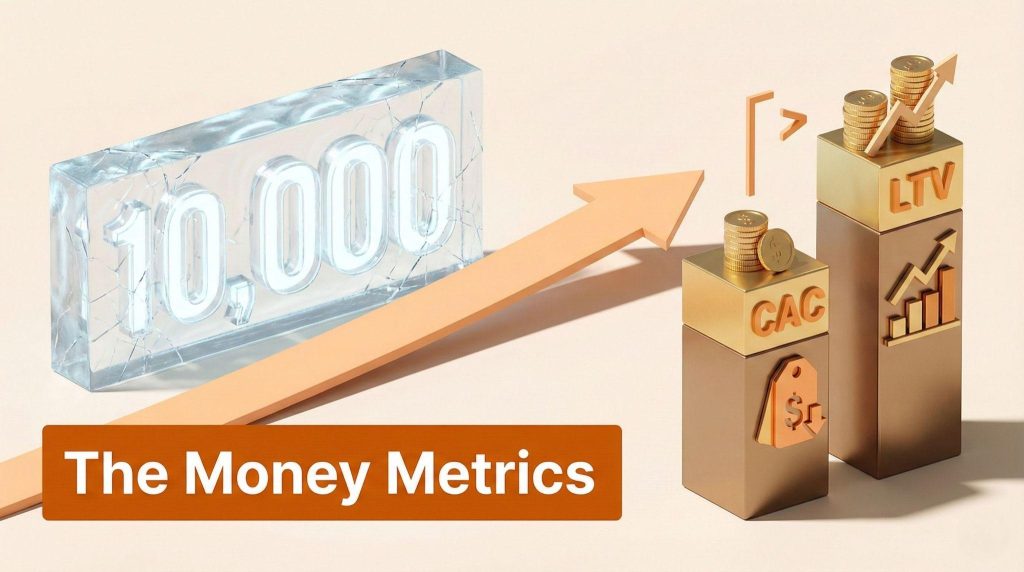
There is a dangerous addiction in the ecommerce world. It is the addiction to Hits.
Business owners love to say, “We had 10,000 visitors this month!” It sounds impressive. But you cannot pay your suppliers with visitors. You need to stop counting hits and start counting value.
To build a real business, you need to ignore the vanity numbers and focus on the Money Metrics. This is the core of data-driven growth.
There are only two numbers that truly matter. If you know them, you can win. If you don’t, you are flying blind.
CAC (Customer Acquisition Cost)
This is the price tag of a new customer.
Think of it this way: If you spend $100 on Facebook ads and you get 10 customers, your CAC is $10. You essentially paid $10 to “buy” that customer.
Many business owners don’t know this number. They just know they spent “$5,000 on marketing.” But if you don’t know the price per customer, you don’t know if you are making a profit.
LTV (Customer Lifetime Value)
This is how much that customer is worth to you over time.
Most beginners focus on the first sale. “They bought a $20 shirt.” But a smart business owner asks, “Will they come back?”
If that customer buys a $20 shirt today, a $50 jacket next month, and a $30 hat next year, their Customer Lifetime Value (LTV) is $100.
The winning formula
Once you have these two numbers, business becomes a simple math equation.
- If your CAC is higher than your LTV, you are losing money on every sale. Stop spending immediately. You will go bankrupt.
- If your LTV is higher than your CAC, you have a money-printing machine. You can spend $10 to make $100. You should spend as much as possible.
This is the secret to scaling. The businesses that grow huge don’t just have “better ads.” They have better math. They know exactly how much they can afford to spend to get a customer, and they know exactly how to make that customer come back.
Stop guessing. Calculate your CAC. Calculate your LTV. If you don’t know these numbers, put your wallet away.
Your roadmap to revenue
We have covered a lot of ground. If you are feeling overwhelmed, take a deep breath.
The most important takeaway is this: Growth is not magic. You do not need to be a genius, and you do not need to get lucky.
Growth is a system. It is engineering.
When you stop looking for “hacks” and start building a sustainable growth engine, the path becomes clear.
- Diagnose: Find the leak in your bucket.
- Trust: Prove to your customers that you are real.
- Fix: Remove the friction from your checkout.
- Scale: Use your LTV and CAC numbers to spend money safely.
Start small
Do not try to do all of this tomorrow. That is the quickest way to fail. Instead, pick just one bottleneck we discussed.
Maybe this week, you can just add your phone number to the header. Maybe next week, you test “Guest Checkout.” Small changes, when stacked on top of each other, lead to massive results.
The traffic is out there. The customers are waiting. You just need to build the framework to welcome them in.
For detailed case studies and more advanced frameworks like this, you can always explore the CustomLiftBD blog.