Step inside any thriving Australian business and you will probably witness a familiar juggling act: job management in one browser tab, inventory in another, subscription billing on a separate screen, ecommerce running solo, and a trusty spreadsheet desperately tying the chaos together. Each tool fixes a single issue, but together, they weave a fresh set of headaches.
This is the fragmented software stack. And for thousands of Australian businesses, it’s quietly draining time, money, and operational clarity every single day.
Integration headaches are mounting for SMBs, as disconnected systems make scaling feel like an uphill battle. Meanwhile, SaaS costs per user keep climbing as businesses stack new tools atop old ones, never quite bridging the gaps.
Enter Hykmah, stepping into this landscape with a bold promise: one platform, countless products, and an end to endless migrations.
Why fragmentation is getting more expensive

The global SMB software market was valued at approximately USD 68 billion in 2024 and is projected to exceed USD 124.53 billion by 2033, according to some industry estimates.
Despite a flood of new tools each year, operations have not become any simpler. Many businesses juggle dozens of apps, piling up operational headaches when those systems refuse to play nicely together.
The result? Fragmented data, tedious manual entry, and tangled reporting across a maze of platforms. When workflows span inventory, billing, fulfilment, and CRM, mistakes multiply with every handoff.
Meanwhile, tight budgets and talent shortages keep SMBs from embracing and managing modern systems. The outcome is all too familiar: businesses spend more hours wrangling their tools than actually running their business.
What Hykmah is building
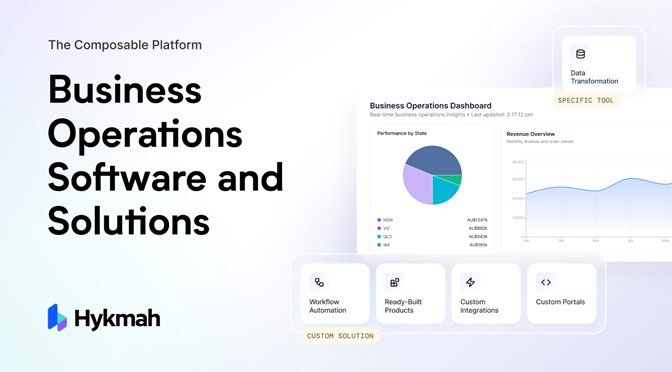
Hykmah describes itself as a composable business ecosystem, a platform that lets Australian companies start with the specific tool they need and grow into a fully integrated suite without ever switching vendors, migrating data, or logging into a new system.
The platform spans four major categories:
Operations: Operon for field service and job management, Stockwise for multi-channel inventory, Rentalux for equipment rental and asset management, and Wirkolic for professional services.
Commerce: Sellwise for D2C ecommerce, Orderlink for B2B ordering portals, Marketbridge for marketplace and vendor financial management, and Ticketime for event ticketing and venue operations.
Engagement: Recuron for subscription and recurring billing, Membrify for membership management, and Fitstream for fitness studio operations.
Industry solutions: Ozchain for franchise networks, Dwellvio for property management, Clynia for healthcare, Trainoz for education, and Buildtrack for construction.
Hykmah stands apart from a patchwork of SaaS tools because everything runs on a single foundation: all 16 products share a single platform, data model, and subscription. Adding another product is as simple as flipping a switch, not starting over.
This makes a real difference. A field service business using Operon for job management can bring in Stockwise for inventory with zero data imports, no integration headaches, and no need to retrain staff. Customer records, job history, and billing are already seamlessly connected.
Industry depth over generic configuration
Hykmah’s approach is intentional: instead of offering generic modules and leaving businesses to piece them together, it crafts workflows tailored to the real-world needs of each industry.
Managing a franchise network requires consistent reporting across multiple entities, compliance enforcement, and centralised oversight without stripping local autonomy. Generic ERP systems are priced for enterprise and designed for single-entity businesses. Ozchain targets that gap directly.
Equipment rental operators need to track asset location, maintenance schedules, availability calendars, customer deposits, and utilisation rates simultaneously. Rentalux is built around those exact requirements. The same targeted design logic applies to Clynia for healthcare, Buildtrack for construction, and Fitstream for fitness studios.
This level of specificity matters. Generic tools demand heavy internal setup to mimic industry workflows, costing time, inviting errors, and often leaving businesses with clunky, incomplete solutions.
Integrations that bridge the transition
Solving fragmentation does not mean forcing businesses to ditch their favourite tools. Hykmah bridges the gap with over 73 pre-built connectors spanning the most popular business software categories.
Accounting integrations cover the dominant Australian tools Xero, MYOB, QuickBooks, NetSuite, and Sage. Payment connectors include Stripe, Square, PayPal, Adyen, and eWAY. For shipping and logistics, Australia Post, FedEx, DHL, and Aramex are supported, a practical acknowledgement that Australian fulfilment realities differ from global templates.
CRM and marketing integrations with Salesforce, HubSpot, Mailchimp, and Klaviyo allow businesses to centralise operations in Hykmah while keeping the customer-facing tools their teams already know.
This design mirrors how businesses really adopt new platforms. Rarely does anyone swap out everything at once. Hykmah’s path is gradual: tackle your biggest pain point first, consolidate step by step, and connect what you want to keep with ready-made integrations.
Transparent pricing in a market known for opacity
Buying software has long been a guessing game when it comes to pricing. Usually, you need a demo, a discovery call, and a proposal before you even see a number; by then, switching costs are already piling up.
Hykmah flips the script. Every product includes a free tier, and paid plans start at $50 per month. Businesses can try, buy, and grow without ever talking to a sales rep, a refreshing approach more common in consumer apps than business operations software.
This shift matches the broader market mood. Australian SMBs are investing more in digital tools, and buyers are savvier and choosier than ever. Transparent pricing cuts through confusion and speeds up decisions.
For businesses with more complex needs, disconnected systems, custom workflows, or multi-entity operations, Hykmah also offers scoped custom solutions built on the same platform, with ongoing Australian support.
For more complex requirements such as system integration, custom workflows, or multi-entity operations, Hykmah also provides tailored solutions supported locally in Australia.
The right platform at the right moment
The conditions for a platform like Hykmah have rarely been better. Cloud deployment now accounts for approximately 72% of the SMB software market and is projected to grow at a 17% CAGR through 2031. Industry research consistently highlights fragmentation challenges, with many SMBs citing integration complexity and limited internal IT capability as key barriers to scaling multi-vendor software stacks.
Australia is home to over 2.6 million active businesses, with more than 97% falling into the small business category. These companies sit in a tricky middle ground: too complex for manual workarounds, but unable to stomach the cost and hassle of big-ticket ERP systems. Yet optimism runs high, with most leaders reporting growth and confidence fueling the appetite for integrated, scalable software.
Final thoughts
Fragmented software stacks are nothing new, but their price tag keeps climbing due to rising subscription costs, integration headaches, wasted staff hours, and poor-quality data for decision-making.
Hykmah’s solution is refreshingly simple: begin with what you need, grow on the same platform, and leave migrations behind. The product range is real, the integration is robust, and the industry focus shows a team that truly understands how businesses tick, rather than just building generic features and hoping for the best.
For any Australian business caught up in tool management instead of actual operations, Hykmah is an option well worth a closer look.