AI software costs anywhere from $15,000 to $800,000 in Australia, and that gap isn’t vendors being cagey with the number. It’s that AI software describes two genuinely different kinds of work. A chatbot bolted onto an existing model is one job. A custom model trained from scratch on your own business data is another job entirely, and it usually costs several times more.
Most quotes never spell out which one you’re buying, which is why business owners end up comparing prices that were never really comparable. Here’s what actually separates a $30,000 project from a $400,000 one, and what the invoice for building it leaves out.
Why do AI project quotes range from $15,000 to $800,000?
Two projects can both be called AI software and cost ten times apart, and the reason usually comes down to one decision: are you building on an existing model, or training something new on your own data? Pre-built tools sit on top of a foundation model and can be configured for $10,000 to $20,000 including setup. A custom model trained on your business’s data starts around $60,000 for a real MVP and climbs from there, because you’re paying for data engineering and model development, not just an interface.
Rates matter too. General senior developer rates in Australia run $150 to $330 an hour at small-to-medium agencies, according to Melbourne firm Conduct, and up to $577 to $1,400 an hour at enterprise consultancies. AI specialists sit above that. Average Sydney-based AI shop, prices senior AI developers at $180 to $280 an hour, reflecting how thin the specialist talent pool is compared to general software work.
A chatbot and a fraud-detection model are both AI. Pricing them the same way is exactly where budgets go wrong.
What does AI software actually cost, by project size?
Here’s how the three common bands break down in the current Australian market, based on figures published by AI development firm Dataclysm and cross-referenced against Abbacus Technologies’ 2026 estimates:
| Project type | What it typically includes | Typical AUD cost |
| Proof of concept | Single use case, testing feasibility before committing budget. | $15,000–$50,000 |
| Basic AI project | Chatbot, workflow automation, document summariser on an existing model. | $30,000–$100,000 |
| Mid-scale AI build | Predictive analytics, custom ML model, integration with existing business systems. | $150,000–$400,000 |
| Enterprise AI system | Regulated-industry deployment, multi-system integration, custom-trained models at scale. | $400,000–$800,000+ |
In short: if a vendor quotes you $40,000 for what sounds like an enterprise-scale build, ask what’s been left out. It’s usually the data work.
What actually pushes an AI project’s price up or down?
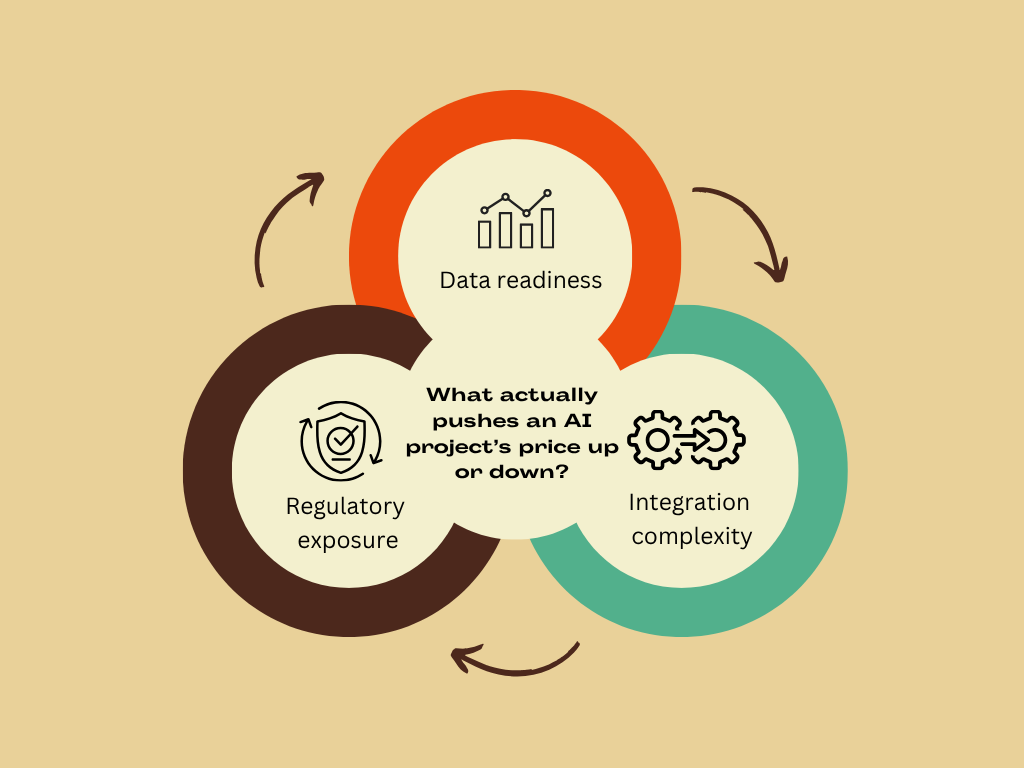
Three factors do most of the work here, and none of them is how advanced the AI is.
1. Data readiness
If your data is clean, structured, and already sitting in one place, you skip weeks of preparation. If it’s scattered across spreadsheets, PDFs, and someone’s inbox, expect data cleaning and labelling to eat a meaningful chunk of the budget before any model work starts.
2. Integration complexity
A standalone tool is cheap. A tool that needs to read from your CRM, write to your finance system, and respect your existing permissions structure is not every connection point is more testing, more edge cases, more things that can break quietly.
3. Regulatory exposure
Healthcare, finance, and government-adjacent work carries compliance overhead that a marketing chatbot doesn’t. Privacy Act obligations and sector-specific rules add engineering time, and that time shows up in the quote.
The cost most business owners forget to budget for
The invoice for building AI software is not the invoice for owning it.
Infrastructure, hosting, and routine maintenance typically run 15% to 20% of the initial build cost every single year, indefinitely, according to both Conduct and Apptunix’s 2026 cost guides. On a $200,000 build, that’s $30,000 to $40,000 a year just to keep the lights on, before you’ve paid for a single feature update. Models also drift. Data changes, business rules change, and a model trained on last year’s patterns quietly gets worse at predicting this year’s outcomes unless someone retrains it. Budget for that as an ongoing line item, not a one-off.
One lever that genuinely reduces the real cost

Most business owners never mention this to their accountant until it’s too late to claim it. Companies with turnover under $20 million can access the R&D Tax Incentive, a refundable offset equal to the company tax rate plus an 18.5 percentage point premium on eligible AI development spend. That applies to a meaningful share of custom AI build work, not just pure research. Raise it with your accountant before the project starts, because eligibility and documentation requirements are easier to sort out at the beginning than to reconstruct afterwards.
Four questions worth asking before you sign a quote
Whether you’re comparing quotes from an established AI software development agency or weighing an in-house hire against outsourcing, run the decision through these four questions before anything gets signed:
- Are you paying for hours, or for a result? Rate-based billing quietly rewards a vendor for taking longer, since every extra hour is more revenue for them.
- Is this built on an existing model or trained from scratch on your data? This single distinction moves the price more than anything else on this list.
- What does year two cost? Get the maintenance percentage in writing, not a verbal not much, don’t worry about it.
- Who owns the model and the data pipeline once the contract ends? Some vendors build you a black box that only they can touch. That’s worth knowing before you sign, not after.
Get more than one quote, and make sure at least one of them prices what happens after launch, not just what it takes to get there.
Final words
The number that matters most isn’t the one on the first page of the proposal. It’s the one buried in the appendix, or missing entirely: the year-two maintenance line, the retraining schedule, the answer to who owns the model when the contract ends. A vendor who volunteers that number before you ask for it is usually the one who’s done this enough times to know it matters. A $30,000 chatbot and a $400,000 predictive model can both be the right decision for a business. The mistake isn’t picking the wrong band. It’s signing before you know which band you’re actually in.